

The WORLD GATE Project - Walls that Unite
International artistic and cultural cooperation initiative

The World GateWalls that Unite
International artistic and cultural cooperation initiative.
A symbolic bridge between peoples: a collective work that reflects the richness and diversity of the world's cultures.
 America
 Africa
 Europe
The World Gate is a ceramic work made of five bas-relief panels, each devoted to a continent. Side by side, they measure 6 × 2 metres.
Each panel is born in one country and is then created in the other countries of the project as well, by the same artists. Over time, every country will have its own complete version of the work.
Where the work stands- Who
- IsCaPI, with partner institutions and universities in Italy, Egypt, Argentina, Nepal and Australia
- Where
- Belvedere Marittimo (Italy), Galala University (Egypt), Luis Beltrán (Argentina); Nepal and Australia to follow
- When
- From 2023 to 2030, with new stages every year
- To date
- Six panels on the walls: three in Belvedere Marittimo, one in Egypt, two in Argentina

The World Gate proposes itself as a synthesis of past and future, tradition and experimentation, building a tangible bridge between cultures through ceramic art. Within the landscape of contemporary art, where globalisation has generated intersections and cross-fertilisations among languages and cultures, it stands out as an emblematic work of artistic diplomacy and connection among peoples.
Inspired by UNESCO principles on cultural diversity, The World Gate is not merely an artistic initiative, but an instrument of intercultural dialogue that brings together artists from all over the world in a process of collective creation. The work is composed of five ceramic panels, each dedicated to a continent, with final overall dimensions of 6 metres by 2 metres. Each panel (1.20 m × 2 m) becomes not only a representation of the artist's country of origin, but a tribute to the broader cultural heritage of the continent it represents, generating a visual language of strong universal impact.
Coordinated by the Calabrian Institute of International Policies (IsCaPI), the project embodies a principle of collaboration and cohesion among nations, promoting the value of shared artistic creation. Beyond its exhibition function, The World Gate is conceived to be replicated in different countries, building a network of cultural connections that goes beyond the mere completion of the artwork.
Its dynamic nature and the involvement of internationally recognised artists alongside emerging talents make this project a benchmark model for cultural diplomacy, transforming art into a vehicle for mutual understanding and socially sustainable development.
Three of the five panels are complete and mounted on a wall in the historic centre of Belvedere Marittimo, Calabria, in southern Italy: America (2023), Africa (2024) and Europe, unveiled on 16 October 2026. The cycle will be completed by the panels dedicated to Asia and Oceania.
Vision and missionA symbolic bridge between peoples
"The World Gate" is conceived as a symbolic bridge among peoples: a collective artwork that reflects the richness and diversity of global cultures. The objective is twofold: on the one hand, to enhance the artistic and cultural heritage of each continent; on the other, to create a dynamic interaction among the participating artists, stimulating dialogue and international cooperation through the framework of the artist residency.
A network of cooperationTradition and innovation
This initiative is part of a broader programme of cultural cooperation involving academic institutes, universities, local authorities and international bodies. The participation of artists of international standing, combined with the commitment of emerging talents, ensures a balance between tradition and innovation.
One work, many countries
The complete work measures 6 × 2 metres: five panels side by side, each devoted to a continent. Each country in the network puts it together over time. For each place, here are the panels already on the wall and those still to come.
The rotation cycle
A journey through continents and cultures. From 2023 to 2030 the project follows a rotation cycle involving five continents, artists from each of them and the communities that host them. Each year the works are produced in a new destination, weaving together geographies and artistic traditions.
Argentine artists create the "America" panel in Italy, launching the cycle.
ItalyProf. Akmal Abdelrahman creates the "Africa" panel in Italy, while Argentine artists replicate the "America" panel in Egypt.
Italy · EgyptIn November, in Luis Beltrán, the Argentine artists produce the "America" panel and Prof. Akmal Abdelrahman the "Africa" panel, in a workshop open to the public.
ArgentinaOn 1 April the "America" and "Africa" panels are unveiled in Luis Beltrán, Argentina. Angelo Aligia and Julieta Castellan complete the "Europe" panel (Identità), unveiled in Belvedere Marittimo on 16 October during the Summer Peace University 2026.
Argentina · ItalyItalian artists travel to Egypt to create the "Europe" panel, while Prof. Akmal Abdelrahman creates the "Africa" panel in Egypt; Nepali artists create the "Asia" panel in Italy and Argentine artists the "America" panel in Nepal.
Egypt · Italy · NepalAustralian artists join the circuit with the "Oceania" panel, and the rotation continues until all continents are covered, bringing the project to the dimension of global art in motion.
Five continentsEach phase is a stage of a creative journey in which art moves through space and time, making The World Gate an itinerant work.
Three gates already open
Belvedere Marittimo (Calabria, Italy) is the starting point and operational anchor of The World Gate – Walls that Unite: a cultural diplomacy project that uses ceramic mural art as a public instrument for dialogue among heritage, identities and communities, in line with UNESCO principles of cultural diversity, knowledge transmission and participation.
Three continental panels have been produced in Belvedere Marittimo, the result of artist residencies and a process of co-creation with the local community: America (2023), Africa (2024) and Europe (2026). Each panel is a unique artwork carrying a profound cultural and social message.


Abya Yala
- Location
- Belvedere Marittimo (Italy)
- Period
- July–September 2023
- Artists
- Samantha Dunel, Nicolás Gonzalo Pérez, Florencia Pumar (Luis Beltrán, Río Negro Province, Argentina)
- Partnerships
- the municipal administration and the Agorà Association; artistic supervision by master artists Enzo Molino and Angelo Aligia
The panel celebrates the resilience and cultural richness of Latin America. Through vibrant symbols and colours, it represents the continent's capacity to preserve its identity in the face of historical and social adversity.
This first panel opened the project's international cycle: a work that embraces ceramics as a "material archive" of memories and visions, capable of preserving the artistic gesture over time while activating relationships between communities and territories.
Galala University, Egypt: produced in December by the Argentine artists Samantha Dunel, Nicolás Gonzalo Pérez and Florencia Pumar.
Luis Beltrán, Argentina: produced by the same artists in their home town in November 2025 and unveiled on 1 April 2026 at Escuela N° 11.
Nepal: the Argentine artists will create the panel in Nepal.


Roots and Horizons
- Location
- Belvedere Marittimo (Italy)
- Period
- October 2024
- Artist
- Prof. Akmal Abdelrahman, Director of the Visual Arts Program, Galala University (Cairo, Egypt)
The panel expresses the strength and unity of Africa. Iconic elements such as the Eye of Horus, symbol of protection and strength, and the Nile, emblem of continuity and connection among nations, enter into dialogue with a female figure embodying the fundamental role of African women in society.
The second panel develops a symbolic lexicon that intertwines historical roots and future horizons: from the evocation of ancient civilisations to signs of unity and resilience, culminating in the centrality of the female face as an emblem of strength, cultural continuity and prosperity.
Luis Beltrán, Argentina: produced in the open workshop of November 2025 with Prof. Akmal Abdelrahman, and unveiled on 1 April 2026 alongside Abya Yala.
Egypt: Prof. Akmal Abdelrahman will create the panel in Egypt.

Identità
- Location
- Belvedere Marittimo (Italy)
- Unveiling
- 16 October 2026, closing day of the Summer Peace University 2026
- Artists
- master artist Angelo Aligia and Julieta Castellan
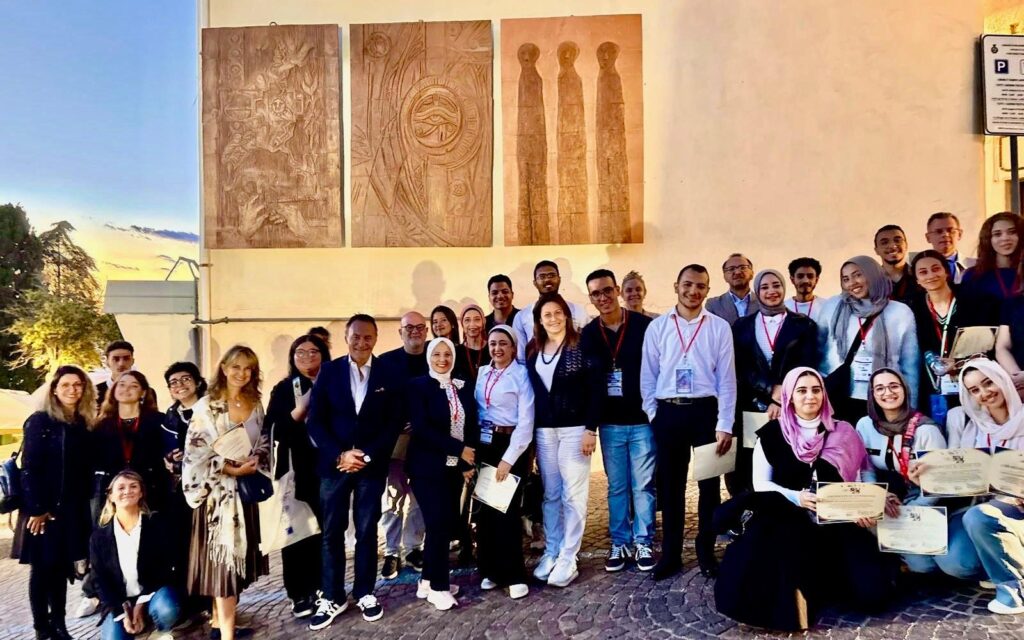
The third panel, dedicated to Europe, presents three anthropomorphic terracotta figures, vertical and hieratic, their faces reduced to a few essential lines. The repetition of the forms holds two readings together: belonging to a shared history, and the risk that individual identities may blur into one another. It is the tension between unity and plurality that runs through European history, made of encounters, at times conflictual, among peoples, cultures and traditions. The terracotta keeps the marks of its making and recalls the ceramic tradition of Belvedere Marittimo, where master artist Aligia has accompanied the project from its earliest stages.
The work was unveiled before the thirty international students, the faculty and the participants of the Summer Peace University 2026, the third edition in Belvedere Marittimo of the advanced training programme promoted by IsCaPI with the Municipality of Belvedere Marittimo and a network of universities and cultural institutions. With Europe, three continents now share the same wall, each with its own language.
Egypt: the Italian artists will create the "Europe" panel in Egypt.
Art becomes a common language and the wall becomes a threshold.
Galala UniversityWorks in Egypt, 2024
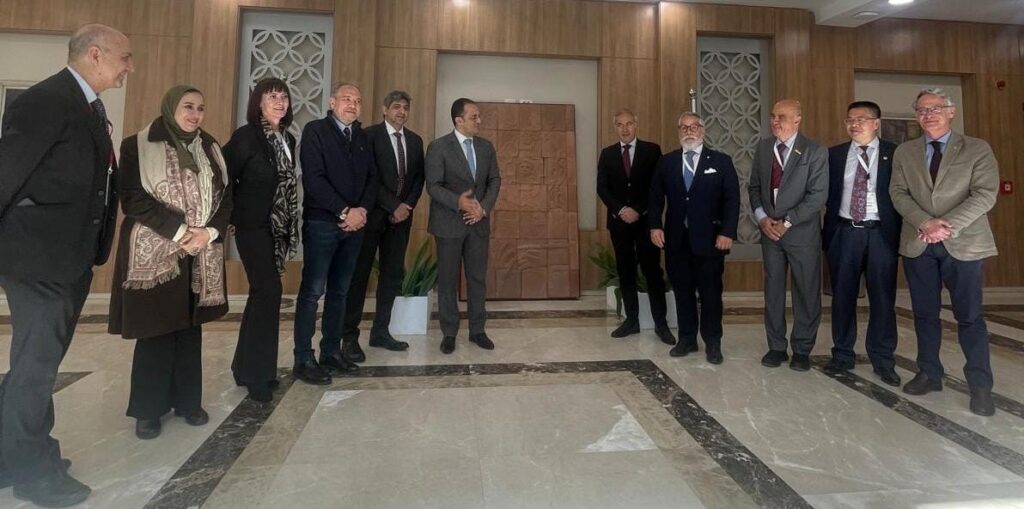
In 2024, The World Gate – Walls that Unite took a strategic step within the wider Mediterranean, arriving in Egypt with a new installation produced at Galala University. This stage strengthens the project's cultural diplomacy dimension: the work does not merely "circulate", but takes root in academic settings capable of turning an artwork into a symbolic infrastructure, a platform for dialogue and cooperation among communities, universities and territories.
- Artwork
- continental panel dedicated to the Americas (Abya Yala – Tierra Madura)
- Authors
- Argentine artists (Luis Beltrán, Río Negro Province, Argentina)
- Event
- unveiling and installation on the university campus
The Abya Yala – Tierra Madura panel brings into the university's public space a visual narrative of plural identities, the memory of peoples and shared horizons: a "cultural geography" built in ceramics, where art becomes a common language and the wall becomes a threshold. The installation at Galala University marks a turning point: the Americas are no longer merely a depicted continent, but a cultural bridge that takes physical form within an educational institution, generating educational and relational value.
Luis BeltránUnveiling, 1 April 2026
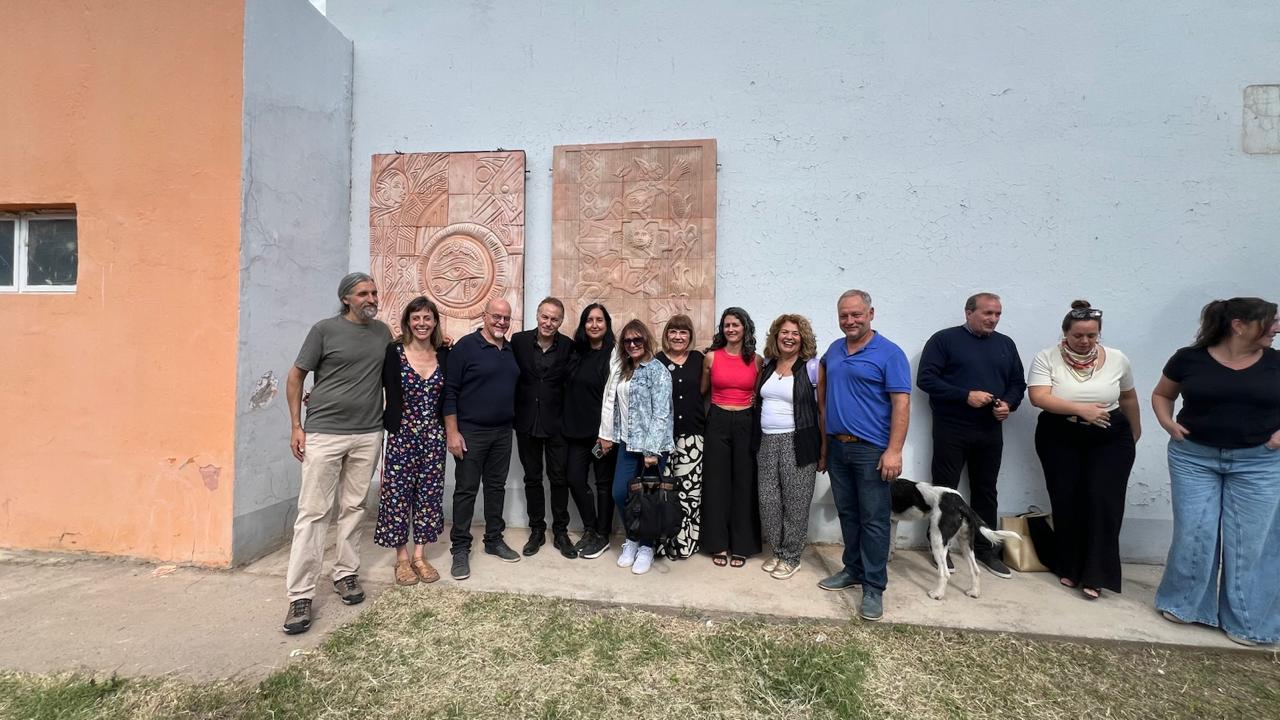
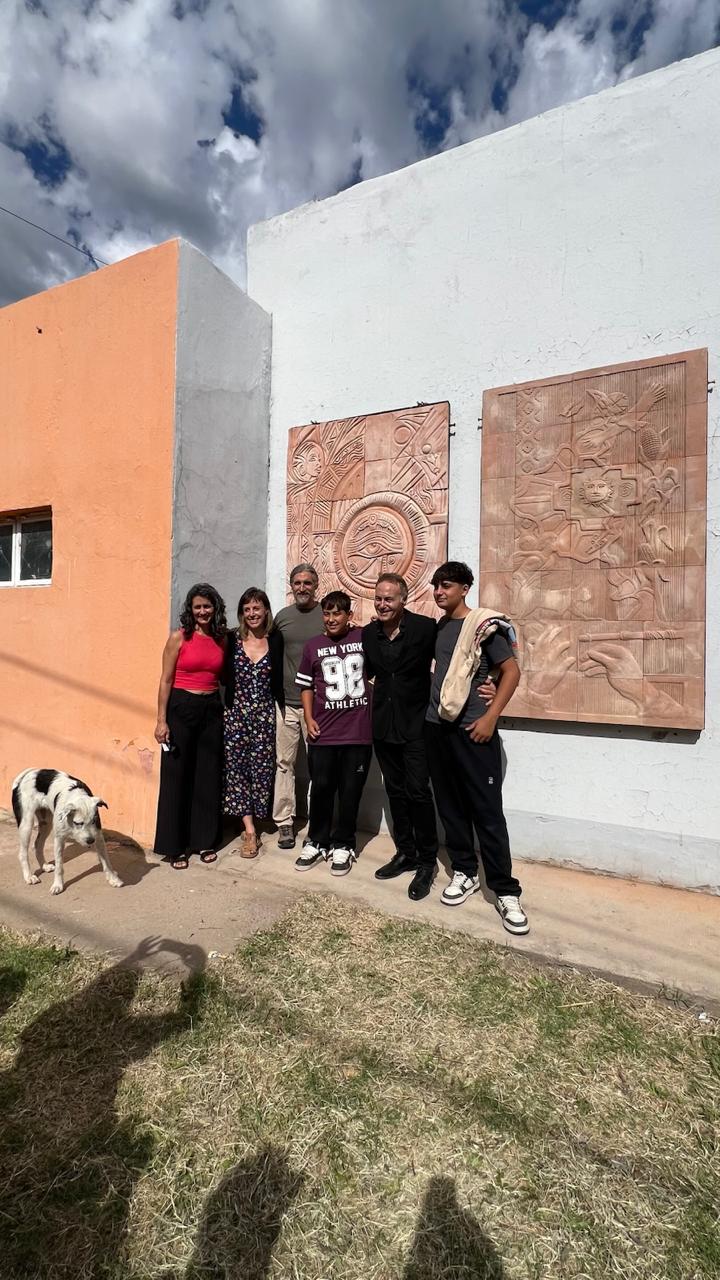
On 1 April 2026 the America (Abya Yala – Tierra Madura) and Africa (Roots and Horizons) panels were unveiled in Luis Beltrán, Río Negro Province, on the wall of Escuela N° 11. It is the home town of Samantha Dunel, Nicolás Gonzalo Pérez and Florencia Pumar, the artists who opened the cycle in Belvedere Marittimo in 2023.
- Location
- Escuela N° 11, Luis Beltrán (Río Negro, Argentina)
- Production
- workshop open to the public, 13–21 November 2025, with Nicolás Gonzalo Pérez, Samantha Dunel, Florencia Pumar and Prof. Akmal Abdelrahman (Galala University, Egypt)
- Presentation
- 22 November 2025, Casa de la Cultura, Luis Beltrán
- Unveiling
- Wednesday 1 April 2026
During the workshop the studio stayed open to residents, who could follow the making of the two panels step by step. The unveiling was attended by the artists, local institutions, and the school's teachers and students.

 The unveiling


How the residencies work
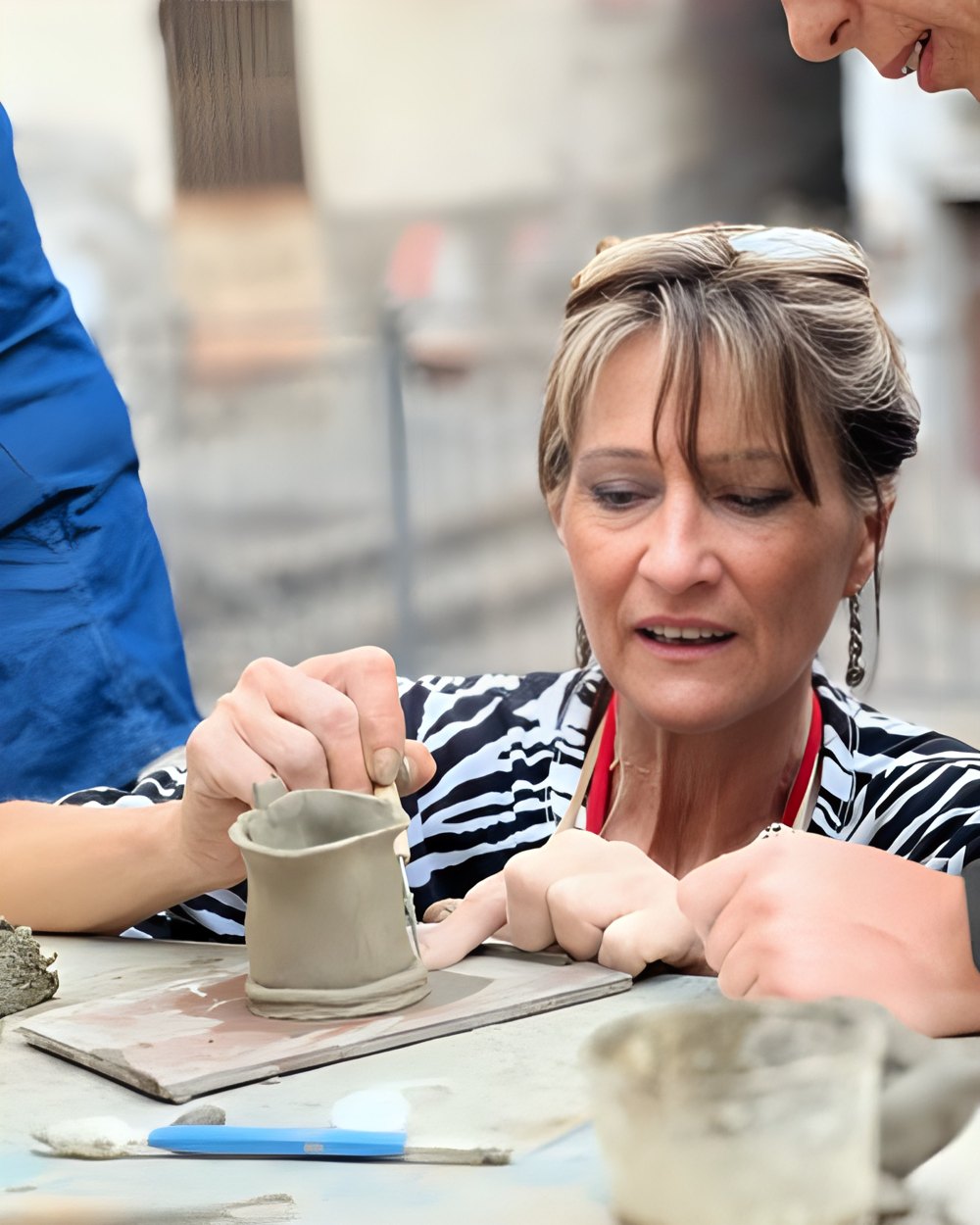
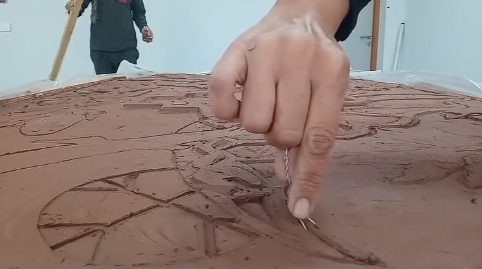
Every stage of the World Gate follows the same international rotation mechanism, in Belvedere Marittimo as in Egypt, Argentina and Nepal: guest artists work in residence for a defined period, with logistical and technical support from the host territory. Production includes the ceramic workflow (drying, kiln firing and assembly) before final installation in the place that hosts the work.
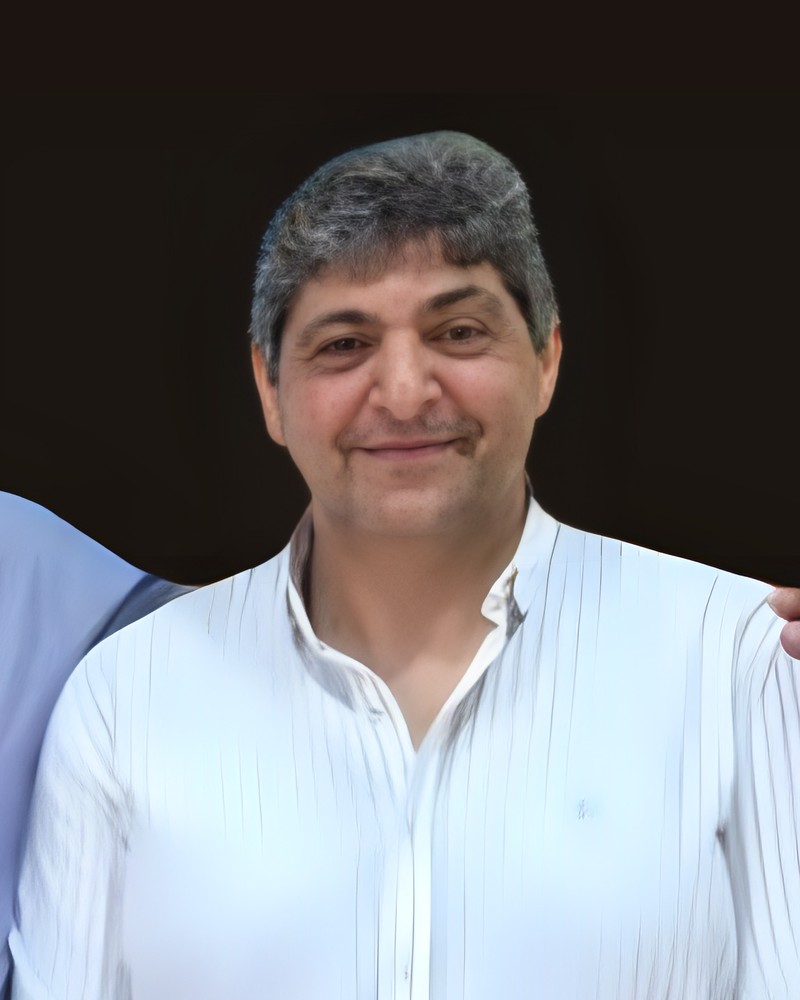
The hands behind the work
The artists and master ceramists who gave shape to the panels, in residence in Belvedere Marittimo and in the partner countries.




A work in motion between continents and memories
The creative journey of The World Gate

Each work is one piece of an ever-expanding global story.
The World Gate is a continuously moving organism, a cultural trajectory that crosses continents.
It leaves tangible traces in the places it touches and generates new collective narratives. The participating artists do not merely create; they become witnesses and carriers of experience, shaping a work that evolves and accumulates layers over time.
The production cycle follows a sequence of rotation: a journey that transforms both the artists and the host communities. Each panel is conceived as a fragment of a universal language, rooted in its context of origin yet expanding outward, carrying the influences and resonances of the places it traverses. Artists create, replicate and reinterpret their work in several countries, building a dialogue between tradition and transformation, identity and cross-pollination.
The artists' journey: a lasting legacy
From the outset of the project, launched in 2023 with the Argentine artists, each phase of creation has left an imprint on the host communities. Each panel, while following an original model, is never a mere reproduction: upon encountering a new territory, the artist may choose to reinterpret details, engaging with the historical and cultural identity of the place. This interaction generates a living archive of experiences, where each work becomes one piece of an ever-expanding global story.
The project does not end with the creation of the artwork; it takes root in host cities through the active participation of local artists, students and communities. Workshops, meetings and educational activities accompany each phase of the process, turning every panel into a tangible testimony of artistic sharing and collective memory. The work is therefore not an isolated installation, but a starting point for new connections that endure over time, leaving an imprint on future generations.
An innovative model
A borderless artistic heritage

A story sculpted in material form crossing borders and connecting generations.
An innovative model for global public art
What sets the project apart is its evolutionary and participatory dimension. While other public works are conceived as static installations, The World Gate is a work in motion, capable of generating new artistic, social and cultural perspectives at every stage of its path.
Looking at the history of global public art, we find references to major participatory works such as Mexican Muralism, which turned city walls into instruments of collective narration, or projects such as JR's "Inside Out Project", which brought giant portraits of ordinary people around the world to create a visual archive of human diversity. The World Gate adds an element of its own to this tradition: a cycle in which each panel is reproduced and reinterpreted in different countries, taking root in the cultures it encounters.
A borderless artistic heritage
By the end of the cycle, the work will be disseminated across all continents, not as a set of isolated panels but as an interconnected system of memories and visual languages. Each panel, created and replicated in several places, will become a testimony of intercultural encounter: a story sculpted in material form, crossing borders and connecting generations.
In an era in which distances shrink yet cultural divisions persist, The World Gate puts forward a simple idea: a public work that belongs to several places at once and links the communities that host it.
Project partners
The project involves a broad network of institutions and international partners.
This network provides logistical and artistic support and strengthens the message of inclusion and cultural dialogue that the project promotes.
The World Gate in the press
Articles and press releases on the project in Italy and around the world, from the media of the countries hosting the panels.
A shared threshold
The World Gate is not only a work of art, but a living architecture of cultural connections, a collective experience that crosses continents, generations and identities. Each panel is a fragment of a universal language shaped by artists and host communities, weaving past, present and future into a borderless dialogue.
A work with no final destination
Unlike traditional public artworks, The World Gate has no final endpoint, but an ever-evolving path. It is not a static installation; it is a work that grows, transforms and generates new cultural trajectories. It does not merely exist to be displayed: it expands, spreads and takes root in the territories that welcome it, turning public art into a participatory process that evolves with each new stage.
A work that lives through time and space
The legacy of this project does not end with the completion of the cycle. The artists trained, the communities involved and the collaborative networks built will continue to generate new opportunities and connections. Each installed panel is not simply a finished work, but an open door to new stories: a tangible sign of art's power to cross borders and create new collective narratives.
A global mosaic of identities and memories
The World Gate is not a work "for" peoples, but "of" peoples. It is a living archive of the world's cultures, a mosaic in which each artist contributes a piece of their own history, leaving traces in the places they encounter. It is not a simple reproduction, but a work that evolves into a collective narrative in continuous expansion. It shows that art is never a boundary, but always a passage, a dialogue, a possibility of mutual discovery.
A message for the future
Supporting The World Gate means believing that art can unite what is divided, weave relationships where distances exist and create shared meanings beyond differences. It means contributing to a project in which different cultures engage through shared work: open, collective and without borders.
A lasting mark on the places it reaches
The importance of The World Gate lies not only in its duration or replicability, but in its capacity to generate a lasting cultural legacy: a work that continues to live beyond its creation and leaves a mark on the territories it crosses. Every panel created, every artist involved, every city that hosts it becomes part of a living work that grows and transforms through time and space.
It is a collective experiment showing how art can be an archive of memory, an instrument of dialogue and a driver of change.
A bridge that stays open
When the cycle is complete and the five great surfaces are spread across the planet, The World Gate will not close: it will remain open, like an invisible bridge connecting artists, visions and generations. Its strength will lie not in being a finished work, but in continuing to inspire, to create bonds and to show that art is the most powerful language humanity has ever had to understand itself and recognise itself as one great cultural mosaic.
This is not only a work of art.It is a gate to the world.
INTRODUCTION
Within the landscape of contemporary art—where globalisation has generated intersections and cross-fertilisations among languages and cultures—The World Gate stands out as an emblematic work of artistic diplomacy and connection among peoples. This project proposes itself as a synthesis of past and future, tradition and experimentation, building a tangible bridge between cultures through ceramic art.
Inspired by UNESCO principles on cultural diversity, The World Gate is not merely an artistic initiative, but an instrument of intercultural dialogue that brings together artists from all over the world in a process of collective creation. The work is composed of five ceramic panels, each dedicated to a continent, with final overall dimensions of 6 metres by 2 metres. Each panel (1.20 m × 2 m) becomes not only a representation of the artist’s country of origin, but a tribute to the broader cultural heritage of the continent it represents—generating a visual language of strong universal impact.
Coordinated by the Calabrian Institute of International Policies (ISCaPI), the project embodies a principle of collaboration and cohesion among nations, promoting the value of shared artistic creation. Beyond its exhibition function, The World Gate is conceived to be replicated in different countries, building a network of cultural connections that goes beyond the mere completion of the artwork.
Its dynamic nature—and the involvement of internationally recognised artists alongside emerging talents—makes this project a benchmark model for cultural diplomacy, transforming art into a vehicle for mutual understanding and socially sustainable development.
VISION AND MISSION
“The World Gate” is conceived as a symbolic bridge among peoples: a collective artwork that reflects the richness and diversity of global cultures. The objective is twofold: on the one hand, to enhance the artistic and cultural heritage of each continent; on the other, to create a dynamic interaction among the participating artists, stimulating dialogue and international cooperation through the framework of the artist residency.
This initiative is part of a broader programme of cultural cooperation involving academic institutes, universities, local authorities, and international bodies. The participation of artists of international standing, combined with the commitment of emerging talents, ensures a balance between tradition and innovation.
THE ARTISTIC VALUE OF THE WORK
The Creative Journey of the World Gate Project: A Work in Motion Between Continents and Memories
The World Gate Project is far more than an artwork: it is a continuously moving organism, a cultural trajectory that crosses continents, leaving tangible traces in the places it touches and generating new collective narratives. The participating artists do not merely create; they become witnesses and carriers of experience, shaping a work that evolves and accumulates layers over time.
IThe production cycle follows a sequence of rotation: a journey that transforms both the artists and the host communities. Each panel is conceived as a fragment of a universal language—rooted in its context of origin yet expanding outward, carrying the influences and resonances of the places it traverses. Artists create, replicate, and reinterpret their work in multiple countries, building a dialogue between tradition and transformation, identity and cultural cross-pollination.
The Artists’ Journey: An Enduring Legacy
From the outset of the project—launched in 2023 with Argentine artists—each phase of creation has left an imprint on the host communities. Each panel, while following an original model, is never a mere reproduction: upon encountering a new territory, the artist may choose to reinterpret details, engaging with the historical and cultural identity of the place. This interaction generates a living archive of experiences, where each work becomes one piece of an ever-expanding global story.
The project does not end with the creation of the artwork; it takes root in host cities through the active participation of local artists, students, and communities. Workshops, meetings, and educational activities accompany each phase of the process, transforming every panel into a tangible testimony of artistic sharing and collective memory. The work is therefore not an isolated installation, but a starting point for new connections that endure over time, leaving an imprint on future generations.
The Rotation Cycle: A Journey Through Continents and Cultures
From 2023 to 2028, the project will follow a rotation cycle involving five continents, dozens of artists, and numerous local communities. Each year, the works will be realised in a new destination, weaving together geographies and artistic traditions:
- 2023: Argentine artists create the “America” panel in Italy, launching the cycle.
- 2024: Egyptian artists create the “Africa” panel in Italy, while Italian artists work on the “Europe” panel in Italy, and Argentine artists replicate the “America” panel in Egypt.
- 2025: Italian artists produce the “Europe” panel in Italy, while Egyptian artists bring the “Africa” panel to Argentina, and Argentine artists produce the “America” panel in Argentina.
- 2026: Nepali artists create the “Asia” panel in Italy; Italian artists produce the “Europe” panel together with Egyptian artists, who create the “Africa” panel in Egypt. Argentine artists create the “America” panel in Nepal.
- 2027: Australian artists join the circuit with the creation of the “Oceania” panel in Italy, expanding the network of artistic connections.
- 2027–2029: The rotation continues until all continents are covered, bringing the project to a dimension of global art in motion.
Each phase is a stage of a creative journey in which art moves through space and time, transforming the World Gate Project into an unprecedented itinerant work.
An Innovative Model for Global Public Art
This project distinguishes itself from any other international artistic initiative through its evolutionary and participatory dimension. While other public works are conceived as static installations, the World Gate Project is a work in motion—capable of generating new artistic, social, and cultural perspectives at every stage of its path.
Looking at the history of global public art, we find references to major participatory experiences such as Mexican Muralism, which transformed city walls into instruments of collective narration, or projects such as JR’s “Inside Out Project”, which brought giant portraits of ordinary people across the world to create a visual archive of human diversity. Yet none of these initiatives has developed a cycle of reproduction and artistic reinterpretation on a worldwide scale comparable to the World Gate Project, which not only expands in space but evolves and takes root within the cultures it encounters.
A Borderless Artistic Heritage
By the end of the cycle, the work will be disseminated across all continents—not as a set of isolated panels, but as an interconnected system of memories and visual languages. Each panel, created and replicated in multiple places, will become a testimony of intercultural encounter: a story sculpted in material form, crossing borders and connecting generations.
In an era in which distances seem to shrink yet cultural divisions persist, the World Gate Project represents a visionary experiment: a work that challenges the very concept of public art, transforming it into a collective, unstoppable process.
There is no other artistic project that grows across continents and is nourished by encounters among peoples, leaving a tangible and intellectual imprint in every country that hosts it. The World Gate Project is the greatest itinerant artistic experiment of contemporary times—an idea destined to redefine the relationship between art, memory, and territory.
PROJECT PARTNERS
The project involves a broad network of institutions and international partners
- Italy: Calabrian Institute of International Policies (ISCaPI), Municipality of Belvedere Marittimo.
- Egypt: Galala University.
- Argentina: Municipality of Luis Beltrán, Province of Río Negro,Universidad de Rio Negro
- Nepal: Crown Institute, Pilli e Bhaktapur.
- Australia (dal 2026): Crown Institute Australia, City of Melbourne.
This network guarantees logistical and artistic support and strengthens the project’s message of inclusion and cultural dialogue.
COMPLETED PANELS
Each panel of “The World Gate” is a unique artwork, carrying a profound cultural and social message.
:Panels realised in Italy
- 2023 – Abya Yala – Tierra Madura (America): Created by the Argentine artists Samantha Dunel, Nicolas Gonzalo Perez, and Florencia Pumar, this panel celebrates the resilience and cultural richness of Latin America. Through vibrant symbols and colours, it represents the continent’s capacity to preserve its identity in the face of historical and social adversity.
- 2024 – Roots and Horizons (Africa): Created by the Egyptian professor Akmal Abdelrahman, Director of the Visual Arts Programme at Galala University, this panel expresses the strength and unity of Africa. Iconic elements such as the Eye of Horus, symbol of protection and strength, and the Nile, emblem of continuity and connection among nations, enter into dialogue with a female figure embodying the fundamental role of African women in society.
Panels realised in Egypt
Panels realised in Egypt
- 2024 – Abya Yala – Tierra Madura (America): Created by the Argentine artists Samantha Dunel, Nicolas Gonzalo Perez, and Florencia Pumar, in Egypt at Galala University, in December.
These panels were produced in Argentina:
- 2025 – Abya Yala – Tierra Madura (America): Created by the Argentine artists Samantha Dunel, Nicolas Gonzalo Perez, and Florencia Pumar, this panel celebrates the resilience and cultural richness of Latin America. Through vibrant symbols and colors, it portrays the continent’s ability to preserve its identity in the face of historical and social adversity.
- 2025 – Roots and Horizons (Africa): Created by the Egyptian professor Akmal Abdelrahman, Director of the Visual Arts Program at Galala University, this panel conveys the strength and unity of Africa. Iconic elements such as the Eye of Horus—symbol of protection and power—and the Nile—an emblem of continuity and connection among nations—interweave with the female figure, which embodies the fundamental role of African women in society.
The World Gate is not only a work of art, but a living architecture of cultural connections—an experience that crosses continents, generations, and identities. Each panel is a fragment of a universal language shaped by artists and host communities, weaving past, present, and future into a borderless dialogue.
An Unprecedented Model for Global Art
Unlike traditional public artworks, The World Gate has no final endpoint, but an ever-evolving path. It is not a static installation; it is a work that grows, transforms, and generates new cultural trajectories. Inspired by major international artistic movements—yet surpassing their limits—it does not merely exist to be displayed: it expands, spreads, and takes root in the territories that welcome it. Like the painted cities of Mexican muralists or the itinerant installations of contemporary practice, it redefines public art by transforming it into a participatory process that evolves with each new stage.
A Work That Lives Through Time and Space
The legacy of this project does not end with the completion of the cycle. The artists trained, the communities involved, and the collaborative networks built will continue to generate new opportunities and connections. Each installed panel is not simply a finished work, but an open door to new stories—a tangible sign of art’s power to cross borders and create new collective narratives.
A Global Mosaic of Identities and Memories
The World Gate is not a work for peoples, but of peoples. It is a living archive of the world’s cultures: a mosaic in which each artist contributes a piece of personal history, leaving traces in the places encountered. It is not a simple reproduction, but a work that evolves, becoming a collective narrative in continuous expansion. It demonstrates that art is never a boundary, but always a passage: a dialogue, a possibility of mutual discovery.
A Message for the Future
Supporting The World Gate means believing that art can unite what is divided, weave relationships where distances exist, and create shared meanings beyond differences. It means becoming part of a global artistic revolution—contributing to a project that redefines how art and cultures dialogue worldwide and proposes a new vision of creativity: open, collective, and without borders.
An Indelible Mark in the History of Art
The importance of The World Gate lies not only in its duration or replicability, but in its capacity to generate an unprecedented cultural legacy—a work that continues to live beyond its creation, leaving an indelible mark in the territories it crosses. Every panel created, every artist involved, every city that hosts it becomes part of a living work that grows and transforms through time and space.
This project is not only a benchmark for the future of international public art: it is a new visual grammar for the contemporary world, a collective experiment demonstrating how art can be an archive of memory, an instrument of dialogue, and a driver of change.
An Open Gate to the World
When the cycle is completed and the five great surfaces are disseminated across the planet, The World Gate will not close—it will remain open, like an invisible bridge connecting artists, visions, and generations. Its strength will not lie in being a finished work, but in continuing to inspire, to create bonds, and to prove that art is the most powerful language humanity has ever had to understand itself and recognise itself as one great cultural mosaic.
This is not only a work of art. It is a gate to the world.
Shopping
Selected Stores
Coupon Deals
FashionFreaks VIP Shopping
Currency Converter
Popular Outlet Stores
Members
Your Account
Renew Subscription
Member Deals
Get VIP Account
Recommend a Friend
About
Contact FF
Magazine Authors
Press Center
Careers at FF
Terms & Conditions
Usage
No part of this online fashion magazine can be re-produced without prior written agreement. If you are looking for press material, you can find it in the about section.
© 2016 FashionFreaks